
While the national debt rose 595%, your dollar lost 49% of its value.
Guess Who They Expect to Pay It.
At the start of 2000 the national debt was $5.8 trillion. On September 30, 2026 the Treasury closed the books at $40.17 trillion. Washington will not default. It doesn’t have to. The bill gets paid quietly — out of what your dollars buy, what your benefits are worth, and what you owe in tax.
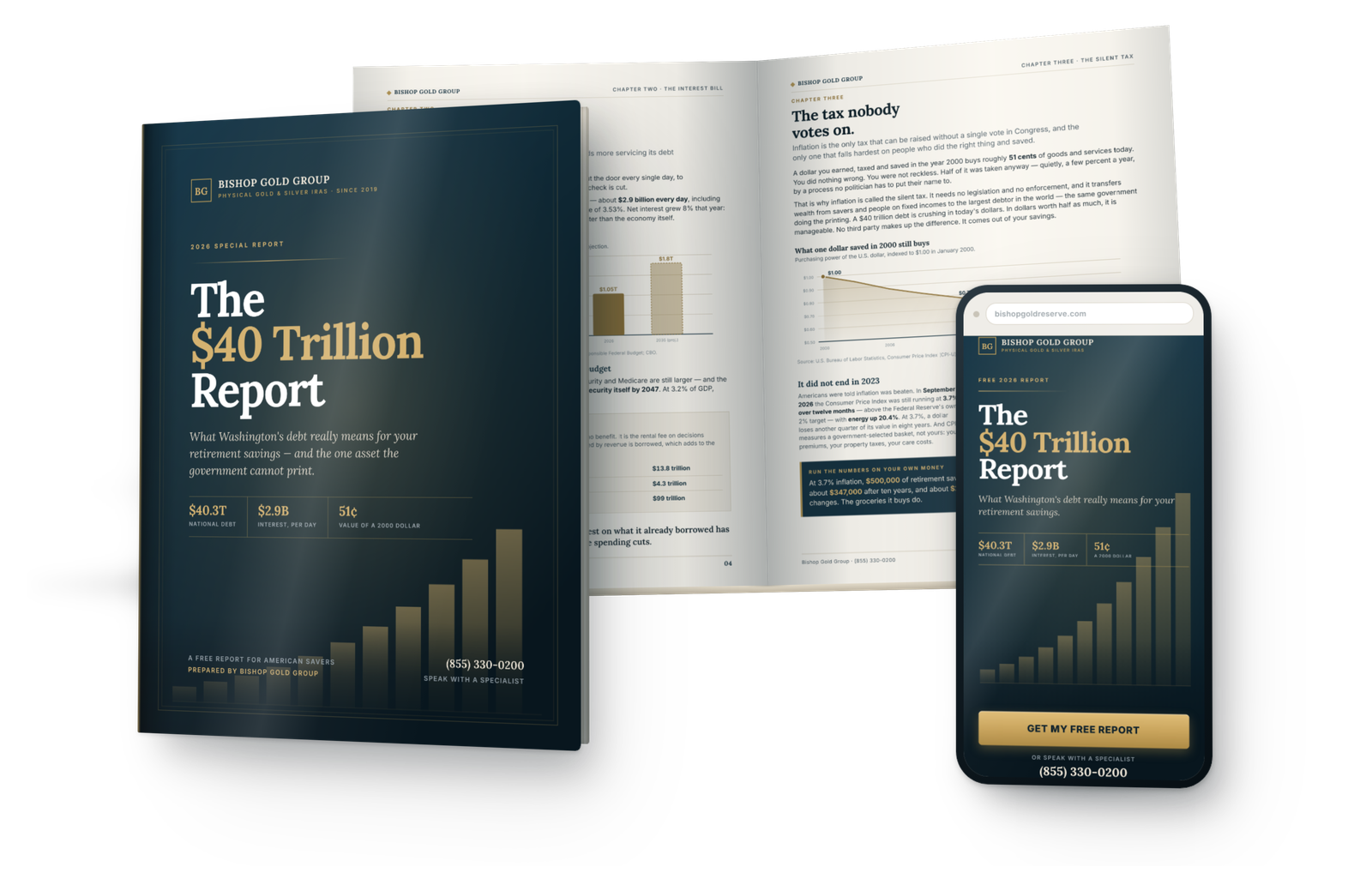
- The three ways federal debt reaches your 401(k)
- Moving a 401(k) or IRA into gold — no taxes, no penalties
- Where your metal is stored, insured and audited
Get Your Free $40 Trillion Report
Instant download. A U.S.-based specialist follows up by phone.
Your information is private and never sold.



- The three ways federal debt reaches your 401(k)
- Moving a 401(k) or IRA into gold — no taxes, no penalties
- Where your metal is stored, insured and audited
Washington can’t pay this back. So it quietly bills you instead.
Dear fellow American,
There is no version of the next twenty years where $40 trillion gets repaid. Nobody in either party has a plan to do it, and nobody is really pretending to. Over the past 12 months the debt grew by $2.4 trillion — about $6.6 billion a day, roughly $76,000 a second.
So the question isn’t whether the bill gets paid. It’s who gets handed the invoice.
It won’t arrive in an envelope. A government that borrows in its own currency has three quieter options, and all three land hardest on the people who already did their saving: inflate the dollar, tax more of what you have, and trim what was promised.
If your money is in a 401(k), or an IRA, all two reach you. Your balance can rise every year while what it actually buys falls. That is the part your statement will never show you.
A Gold IRA lets you hold part of your retirement in physical gold, in your name, with the same tax advantages you have today.
What Washington borrowed while you were working
Seven times larger in one working lifetime — and the curve is steepening, not flattening. Every dollar of it has to come from somewhere: your taxes, your benefits, or the value of the dollars in your account.
Source: U.S. Treasury, Debt to the Penny & Historical Debt Outstanding. Fiscal year-end (Sept. 30) figures.
Forget the political argument. Look at what it has already cost.
None of these numbers are forecasts or opinions. They are the official record, then and now.
Sources: U.S. Bureau of Labor Statistics consumer price index (a 2000 dollar has about 51 cents of purchasing power today, 94.5% cumulative inflation); U.S. Treasury, Debt to the Penny; net interest outlays, Treasury and Congressional Budget Office ($375 billion in FY2019, $971 billion in FY2025, above $1 trillion in FY2026); Congressional Research Service and Social Security Administration on taxation of benefits. Figures are historical and do not predict future results.
The $32,000 line hasn’t moved since 1984.
When Congress decided to tax Social Security benefits, it set the trigger at $25,000 for a single filer and $32,000 for a couple — and never indexed it to inflation. Prices have roughly tripled since. Your cost-of-living raise pushes you over a line that stays frozen. Fewer than one in ten retirees owed that tax in 1984. The projection now runs to about 56%.
The trust fund runs dry
The 2026 Trustees Report moved Social Security’s retirement trust fund depletion to 2032. At that point benefits fall automatically by about 22% — roughly $18,400 a year for a couple retiring in 2033, according to the Committee for a Responsible Federal Budget.
Six years from here
The debt crossed $40 trillion on August 18, 2026 and has more than doubled in a decade. The Peterson Foundation projects it could reach $50 trillion within six years absent changes to spending or taxes.
Of every tax dollar, to interest
Interest is now the second-largest line in the federal budget, ahead of defense and Medicare. In the first quarter of fiscal 2026 it consumed 22.1% of all federal revenue — money that cannot fund a benefit check.
Sources: 2026 Social Security Trustees Report and CRFB analysis; Congressional Research Service RL32552 on the 1984 and 1993 benefit-taxation thresholds; U.S. Treasury and CBS News on the $40 trillion milestone; Peter G. Peterson Foundation; EPIC Interest Spending Tracker, Q1 FY2026. Projections are the published estimates of third parties and are not guarantees.
Every dollar they create is a claim on your savings. Gold isn’t.
A Treasury bond is a promise from the same government that owes $40 trillion. A dollar is a promise too. Gold is not a promise from anyone — it can’t be issued by a vote, and no Congress can add to the supply.
That is why the same institutions printing the money have spent the last few years quietly buying the metal. Central banks have been net buyers of gold every year for more than a decade.
Gold has its own risks. The price moves, sometimes sharply, and it pays no interest or dividend. But it has no counterparty, no default risk, and no issuer who can decide there should be more of it.
Sources: U.S. Treasury, Debt to the Penny; LBMA PM gold fix $290.25 (Dec 31, 1999); spot gold $4,143/oz (Oct 2, 2026). Price change only; excludes dealer premiums, storage, custodial fees and taxes. Gold has also had long flat and falling stretches. Past performance does not guarantee future results.
What you’ll find inside your free report
A plain-English, 20-minute read written for people 5 to 15 years from retirement, or already retired. No jargon, no hype.
How $5.8 trillion became $40.2 trillion
The borrowing, the interest, and the arithmetic nobody in Washington wants on a campaign poster.
The three ways the debt reaches your retirement
Inflation, the frozen 1984 tax thresholds, and the 2032 trust-fund date — what each one does to a fixed income.
Move a 401(k) or IRA into gold with no taxes or penalties
How a direct rollover from a 401(k), IRA, 403(b) or 457(b) works, step by step.
Where your gold is kept, and the fees to watch
IRS-approved depositories, full insurance, independent audits — plus the costs and traps that catch retirees most.
This report isn’t for everyone
We’d rather be upfront about who it’s written for.
Skip it if you…
- Believe Washington will balance the budget on its own
- Trust that your benefits will be there in full, untouched
- Think inflation is finished and won’t be back
- Are fine with 100% of your retirement tied to paper assets
Read it today if you…
- Have watched prices rise faster than your raise or your COLA
- Expect the next “solution” in Washington to cost savers
- Want part of your savings in something real, in your name
- Are within 15 years of retirement, or already there
Endorsed by Ted Nugent and Sean Spicer
Rock legend Ted Nugent and former White House Press Secretary Sean Spicer are official endorsers of Bishop Gold Group. Two names millions of Americans recognize, standing behind the company that helps retirement savers move part of their savings into physical gold they own.
What retirees say about Bishop Gold Group
Verified 5-star reviews from Trustpilot.
Smooth rollover process
“I was pretty nervous about moving my 401k into gold after I retired last fall. The stock market was just making me too anxious. Sam took the time to explain how the whole rollover process worked step by step. He never pushed me into anything I wasn’t comfortable with. Really glad I made the switch for peace of mind.”
A hedge against uncertainty
“With the banks looking shaky and inflation rising, Bishop Gold Group helped me secure my own bank, so to speak. They walked me through the history of gold as a hedge and made me feel confident that I was making a smart move for my family’s future.”
No grey areas on fees
“They broke down the custodial fees versus the storage fees versus the metal costs. There were no grey areas. I knew exactly where every dollar was going, which is essential when you are managing a retirement account on a budget.”
Reviews quoted from Trustpilot, lightly shortened for length. Individual results vary.
The debt grows $6.6 billion a day. Nobody is coming to fix it for you.
Get the free report, read the official numbers for yourself, then decide what to do with your own money. It takes 30 seconds to request and costs you nothing.